
Merchants
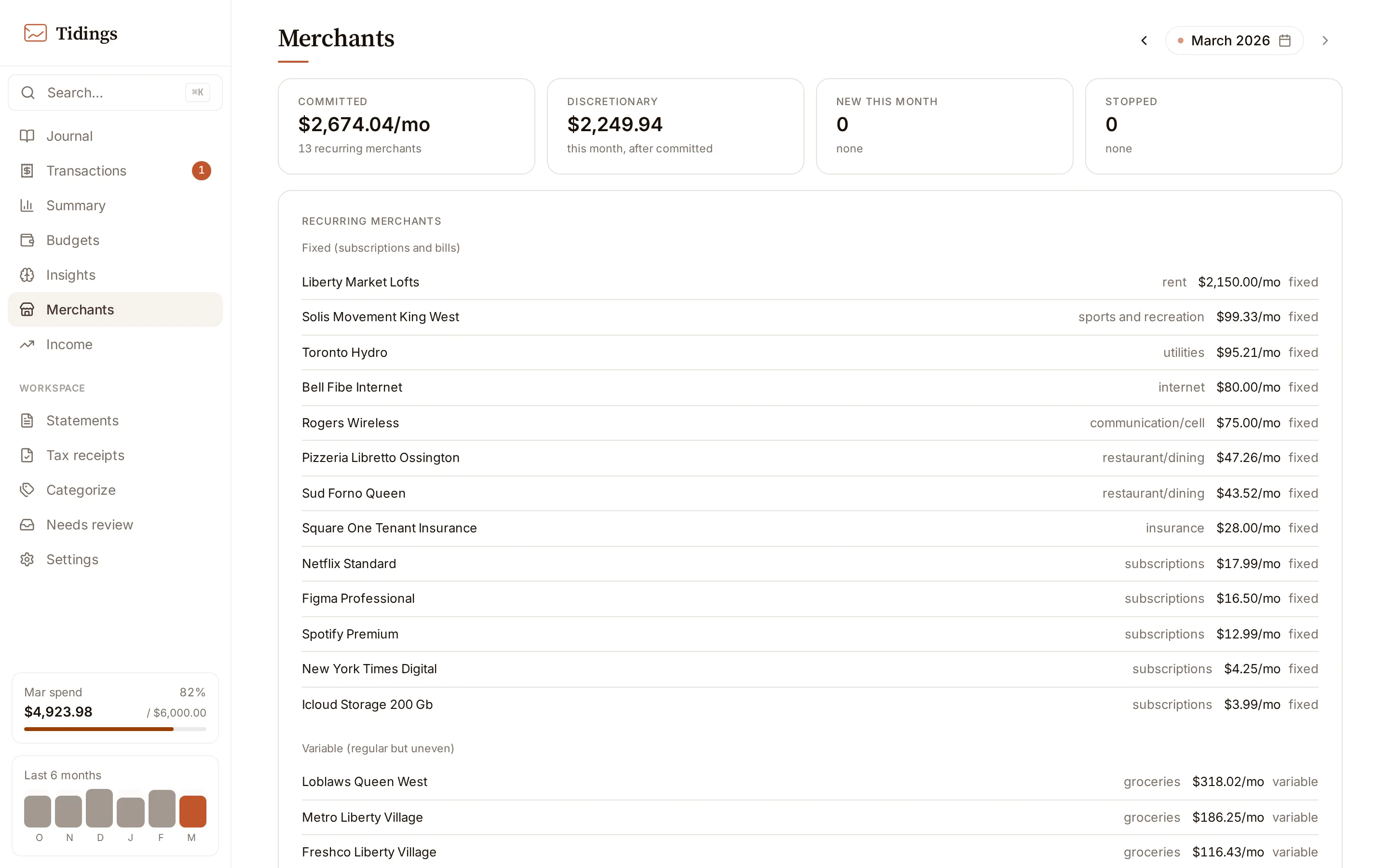
The merchants page looks at who you pay, across the trailing six months. It is read-only — a view over your spending, not a place to edit it — and every figure is derived from data Tidings already has.
Where the numbers come from
Section titled “Where the numbers come from”Nothing new is collected here. The page is built entirely from your existing monthly summaries, the same per-month figures the rest of Tidings runs on. Results are cached for an hour, so a very recent edit — a re-categorized transaction, a merged alias — can lag until the cache refreshes.
Merchants group by canonical alias, so the several raw names one merchant sends collect into a single entry.
How merchants are classified
Section titled “How merchants are classified”Over the six-month window each merchant is sorted by how it recurs:
- Fixed — present every month at a steady amount. These read as subscriptions.
- Variable — present every month, but the amount moves.
- Lumpy — present in some months, not others.
The recurring burn rate is the sum of the fixed merchants’ typical amounts — the spending locked in before the month begins. Discretionary spending is then this month’s total minus that burn rate — what landed this month outside the subscriptions.
Price changes, new, and churned
Section titled “Price changes, new, and churned”For a fixed merchant, Tidings compares its last two active months. If the amount changed by at least 5 percent and at least a dollar, the change is surfaced — a subscription that crept up, seen without you watching for it.
A merchant is marked new when it appears in the last two months but was absent earlier in the window — two consecutive months, so a single one-off charge does not read as a new relationship. A merchant is marked churned when it was active earlier in the window but has gone silent for the last two months.
For the types these classifications share with your budget, see budgets; for how merchant aliases are set, see categorization.